Suffering financial hardship? How banks in your community can help.
Opening a first savings or checking account with birthday money or a first paycheck is a rite of passage for many Americans, but there are millions of adults who are just now doing that or learning how to use their accounts to improve their finances, banking experts say.
In 2024, 4.8 million new Bank On accounts were opened, up 27% from the prior year, according to the St. Louis Federal Reserve. Bank On, an initiative led by the nonprofit Cities for Financial Empowerment Fund, also known as CFE, brings together a coalition of financial institutions nationwide to offer affordable and safe Bank On certified accounts to unbanked and underbanked individuals. By the end of last year, there were more than 14 million active accounts, the St. Louis Fed said.
Access to basic banking services helps people achieve economic stability and build generational wealth, experts said. Without a bank account, households struggle to save, to manage everyday financial transactions and to build a banking relationship that can lead to affordable credit. Financial institutions also provide fraud and loss protection, they said.
“Cash flow is king,” said Seth Schaefer, chief impact officer at Rivermark Community Credit Union. Banking helps customers by providing services such as flexible loans, grants and real-time payrolls without high fees and interest rates, he said.
Unbanked means having neither a checking nor savings account at a bank or credit union. In 2023, a record low 4.2% or 5.6 million householdswere unbanked, according to the Federal Deposit Insurance Corp. That’s down from the peak of 8.2% in 2011, it said.
About 60% of the unbanked are cash-only users, which opens them up to theft or loss each day. They tend to trend older, more likely Hispanic, and are distrustful of banks, the FDIC said.
The other 40% of unbanked households rely on nonbank prepaid cards or payment apps like Venmo or PayPal for everyday financial services like bill paying and receiving money, the agency said.
Underbanked is when households have an account with a bank or credit union but still use nonbank products for most of their financial needs. In 2023, 14.2%, or 19 million households were underbanked, FDIC said.
Top reasons people remain unbanked include high minimum balance requirements, mistrust of banks, and high and unpredictable fees, the FDIC said.
To counter that, banks and credit unions nationwide have worked for years to make banking more inviting. Bank On, which includes all types of financial institutions, and a credit-union only campaign called Backbone promote low- to no-fee accounts and safe products to bring more people into the mainstream financial system.
“There’s a perception it’s a club and you have to qualify to get in,” Schaefer said. “But that’s not the case.”
Often people who had a bank account but bounced checks and accumulated negative balances are declined for another account or discouraged from trying again to open one, bankers said.
“But we let you in,” said Ziquora Banks, chief impact strategy officer at Verity Credit Union. Community-based credit unions might have more flexibility than large institutions to dig into each person’s history, she said.
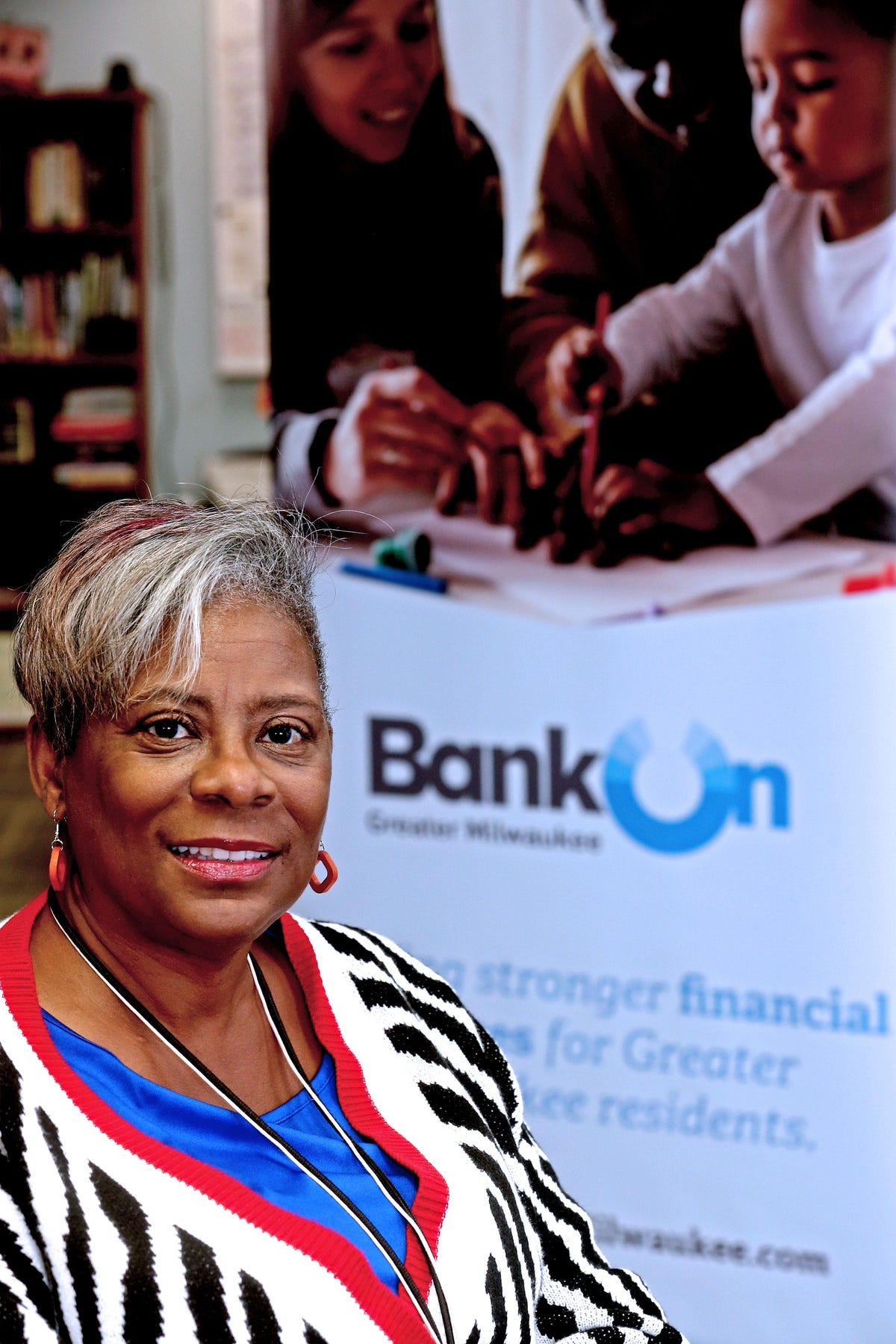
Constance Alberts, program manager of BankOn Greater Milwaukee, an arm of Urban Economic Development Association of Wisconsin on Thursday, Aug. 5, 2021. BankOn Greater Milwaukee works to connect area residents with financial institutions that offer no-to-low cost bank accounts as an options to cash child tax credits than using check cashing services. MJS-BankON00p1
According to United Way, about 42% of households are considered asset limited, income constrained, and employed, or ALICE, up from 32% in 2008. ALICE includes people in poverty (13%) and the 29% who are just above the federal poverty line but can’t afford basic everyday needs like housing, childcare, food, transportation, health care, and basic technology.
They often rely on alternative financial services such as expensive money orders, check-cashing services, and payday loans rather than traditional loans and credit cards to manage their finances and fund purchases, options that often end up costing them a lot of money.
“These are people who need banking services,” Schaefer said. “You can’t buy yourself out of financial hardship.”
Many people are denied bank accounts for as little as a $35 overdraft owed at another bank, he said. Financial institutions can work with those people to find ways to break that cycle. Sometimes it’s setting up real-time payments so someone like an Uber driver can get paid right away and avoid overdrafts.
Or if someone needs to “send money back home to your country, we can support that, so they don’t have to use a higher cost method like wiring money,” Banks said.
Banking also makes it easier, faster and safer to receive government benefits. The urgent need to receive COVID-19 stimulus checks via direct deposit in 2020 pushed many unbanked individuals to open accounts for quick, safe access to funds, according to the Federal Deposit Insurance Corporation (FDIC). Since then, government agencies like the IRS and Social Security have stopped issuing benefits by paper check, forcing millions more Americans to discover banking.
Banks, especially community banks, not only support individuals in the community but also small businesses, which drives growth, studies show.
Credit unions also are locally rooted, making them very community-oriented, Banks said.
When the government recently closed for a record 43 days due to a budget impasse, we “did financial check ins and financial coaching onsite to find out ways in which folks were impacted,” she said. Her credit union launched a community care initiative, delivering $53,000 in financial aid to more than 212 impacted individuals.
“We understand gaps that exist in local communities” and can mobilize quickly, she said. Unlike the largest banks, credit unions answer to their members and communities rather than shareholders.



Leave a Comment
Your email address will not be published. Required fields are marked *