Davos is where some of the world’s most consequential people gather to insist they’re here to listen. They arrive in a postcard-perfect setting with lanyards, chauffeurs, and the serene confidence of someone whose problems can be solved by adding another meeting to the calendar. Davos’ official product is “dialogue.” The useful byproduct is a live read on which rules are about to tighten, which deals are about to come together (or fall apart), and which industries are about to find out what “national interest” means in practice.
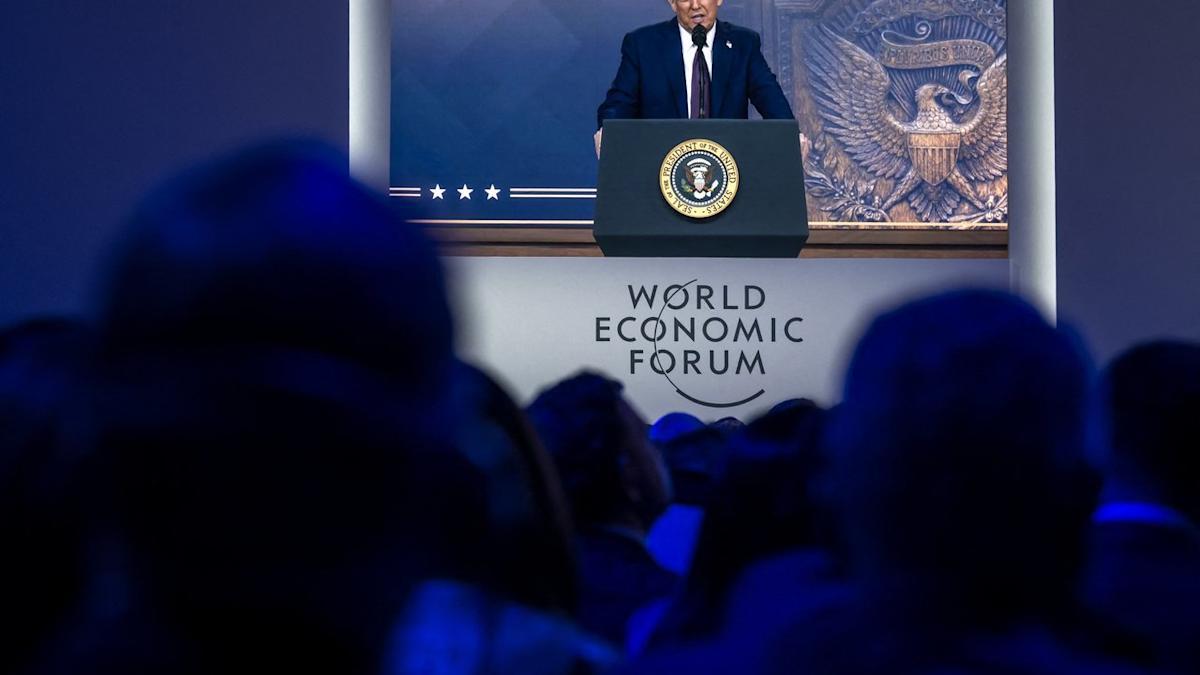
U.S. policy has become the reference point against which other countries and companies model — sometimes with admiration and often with clenched teeth. President Donald Trump is slated to attend the World Economic Forum’s (WEF) Annual Meeting in person; the Trump administration is “coming in force,” Semafor reported, after Davos assured Trump that “woke” topics wouldn’t be on the table, no matter how much climate change is still top of mind for attendees.
The WEF is selling the meeting as a record-setting convening under the theme “A Spirit of Dialogue,” running Jan. 19–23 in Davos, Switzerland. The WEF says close to 3,000 participants are expected, alongside roughly 400 political leaders, close to 65 heads of state and government, and nearly 850 CEOs and chairs. Alongside Trump, the WEF’s press release lists France’s Emmanuel Macron, Germany’s Friedrich Merz, the European Commission’s Ursula von der Leyen, China’s Vice-Premier He Lifeng, and Ukraine’s Volodymyr Zelenskyy. It also lists the heads of the IMF, the World Trade Organization, and the UN — institutions that exist to keep conflicts from swallowing commerce, now operating in a moment when commerce is one of the conflict arenas
The pregame reading supports that idea, only with less romance.
In the WEF’s Global Risks survey, “geoeconomic confrontation” sits at the top of near-term worries, and trade wars show up as a leading fear alongside state-based armed conflict. Half of the survey respondents expect the next two years to be turbulent, and 1% expect calm, a strangely bracing way to describe a world economy that still has to essentially issue earnings guidance. The global economy is being run through a permissions system; the wars are shaping commerce as much as diplomacy; AI is shifting from spectacle to infrastructure; and voters are in a cost-of-living mood that makes every policy choice feel like a bill somebody is trying to hand off to someone else.
“Geoeconomic confrontation” sounds abstract until you translate it into the parts of corporate life that now come with paperwork. Tariffs that reprice inputs. Export controls that turn a product roadmap into a legal question. Investment screening that makes expansion contingent on political acceptability. Procurement rules that quietly redraw who gets to sell what to whom. The WEF’s managing director, Saadia Zahidi, put a sharper edge on it, describing geo-economic confrontation as what happens “when economic policy tools become essentially weaponry rather than a basis of cooperation,” pointing to tariffs, foreign-investment checks, and tighter control over critical-minerals supply.
The U.S. is walking into Davos with tariffs already in motion and more sitting on the launchpad. Trump’s swaggering “America First” posture is part of a broader stress test of the global order that the Davos set usually treats as a given. And the timing is brutal: The White House just described new 25% national-security tariffs on certain high-end semiconductors as a “phase one” move, with officials signaling additional measures could follow depending on negotiations — including the possibility of 100% tariffs on chips not made in the U.S. Meanwhile, the Supreme Court still hasn’t issued a ruling in a case touching Trump’s tariff authority — but one could drop during the week — keeping the legal ceiling on all this a little foggy.
“Tariff relief” from the Trump administration is getting priced like a favor you can buy, not a principle you negotiate. The U.S. and Taiwan just finalized a semiconductor-focused trade agreement that cuts the general tariff rate on a range of Taiwanese exports from 20% to 15%, while locking in at least $250 billion in Taiwanese investment commitments tied to chips, AI, and energy — with preferential tariff treatment designed to reward chipmakers that expand U.S. capacity. That’s the template Davos attendees will be staring at all week: tariffs as the stick, and exemptions as the prize.
Switzerland isn’t just hosting this conversation; it’s living it. Swiss officials adopted a negotiating mandate for a trade agreement after a framework reduced U.S. tariffs on Swiss goods from 39% to 15%, alongside Swiss tariff concessions on select U.S. products. Even if executives in the audience prefer their politics quiet and their supply chains quieter, the signal is hard to miss: Tariff policy can show up fast, expand faster, and get framed as loyalty tests rather than economics.
The trade-war story is already loud enough in Davos corridors, and hot wars keep showing up in the same conversations. Conflict is arriving as policy, pricing, and permissions — often in that order. The war in Ukraine remains the kind of continued force that hardens blocs, locks in sanctions assumptions, and turns “long term” into a euphemism for “until someone runs out of patience.” Israel’s war on Gaza is already bleeding into Davos conversations through side meetings on supposed ceasefire durability, reconstruction financing, and what governance looks like when the fighting pauses but the politics don’t. Arab leaders are expected in force, and diplomats are quietly signaling that any postwar roadmap — who pays, who administers, who guarantees security — is inseparable from the same trade, energy, and capital flows executives are trying to model.
The WEF’s survey nods to the U.S. invasion of Venezuela as part of the context for this year’s anxieties. A noticeable contingent of top oil executives is expected back in Davos after years of spottier attendance: Trump’s energy dominance rhetoric is a draw, and the energy constraints under the data-center and AI boom make the oil conversation newly unavoidable in rooms that used to pretend it was impolite to talk about.
Trump’s return to Davos matters because the U.S. is both the engine and the enforcement arm in a lot of these “geoeconomic confrontation” dynamics.
The U.S. remains central to the global tech stack, the global capital stack, and the global security stack, and the U.S. also has an unusually large toolkit for changing the rules around all three. U.S. trade policy has become a forward guidance problem. The more it gets framed as a national advantage and domestic politics, the less it behaves like a predictable input for global business. Davos doesn’t fix that, but it does offer something executives are increasingly desperate for: a week where the people writing the rules are in the same place as the people trying to follow them.
AI is the thing Davos still wants to talk about as a future, even though it’s very obviously the present. And the WEF has shown how quickly the conversation has shifted from admiration to anxiety: “Adverse outcomes of AI” shows the starkest rise in the Global Risks rankings over time, moving from No. 30 on the two-year outlook to No. 5 on the 10-year outlook — a neat way of saying the downside case is now part of the mainstream forecast, not a footnote for ethicists and sci-fi writers. The risk report ties the concern to labor markets, societies, and security, which is exactly why the AI debate keeps getting pulled out of the “tech” bucket and into the “rules” bucket.
The WEF’s press release lists “top voices in technology and innovation” that read like the spine of the current AI economy: Nvidia CEO Jensen Huang, Microsoft CEO Satya Nadella, Anthropic CEO Dario Amodei, Amazon CEO Andy Jassy, Google DeepMind CEO Demis Hassabis, Palantir CEO Alex Karp, and OpenAI CFO Sarah Friar, among others. They want a sense of how the AI buildout gets financed, regulated, and politically tolerated. They want to know whether the “responsible deployment” rhetoric is going to translate into workable rules or into vague principles. They want to understand which parts of the stack are becoming national assets, and which are becoming political liabilities.
CEOs want to talk about building, deploying, and profiting from AI at an industrial scale — the risk people want to talk about what happens when geopolitics and governance turn that scale into fragility. WEF’s Zahidi called the risks “an early warning system” for an “age of competition” that’s compounding risks from geoeconomic confrontation to “unchecked technology.” The future is still malleable, but the time for soft assurances is running out.
Davos’ AI talk will be about whether deployment outruns governance and about how much disruption is tolerated before regulators, courts, and politics start writing the constraints in pen. Labor is the obvious flash point, because that’s where productivity gains become job losses, and where promises about “augmentation” meet the simple reality of budgets. Trust is the second flash point, because AI is increasingly embedded in everything, and failure’s reputational blast radius isn’t theoretical anymore.
The part of the AI story that Davos can’t charm its way through, though, is the one that keeps dragging the conversation into unglamorous nouns. Data centers. Grid capacity. Interconnection. Transmission. Time. AI is being built as infrastructure, and infrastructure has a calendar that doesn’t care how excited people are. You can announce capacity faster than you can power it, and you can buy chips faster than you can build the systems that make those chips productive.
And because this is Davos, the question isn’t simply “What’s the right regulation?” The questions are becoming “Whose regulation wins?” and “Who gets carved out?” The public line will likely be “responsible innovation.” The private line will be about how to keep shipping and training and deploying without being trapped between jurisdictions that want different things — or between voters who want lower bills and companies that need more power to run the systems they keep promising will make everything cheaper.
Davos always talks about growth. This year, it also has to talk about what growth feels like — because the 2026 affordability conversation is a bridge that makes all of this feel politically combustible. Trump has said he plans to talk in Davos about his administration’s efforts to tackle high prices — a very on-purpose message in a year when affordability has become a political problem for the White House and congressional Republicans.
For business, affordability isn’t a soft concern. It shapes demand. It shapes regulation. It shapes how much time policymakers can spend on long-term projects before they get yanked back into emergency politics. It also shapes the political tolerance for the AI buildout itself, because data centers don’t just consume power; they consume patience. In today’s climate of high bills and tight budgets, the public’s appetite for subsidizing someone else’s infrastructure is limited, no matter how many productivity graphs get flashed on stage.
This year, Davos could look like a live negotiation over who gets to offload risk. Trade policy risk. AI risk. Energy constraint risk. Price level risk. Affordability risk. And institutional trust risk — including the Federal Reserve’s (lack of) independence that’s hovering in the background as part of the broader “rules-based order” stress test.
The people in the rooms this week are selling solutions, but they’re also trying to make sure they’re not the ones left holding the bag when voters, regulators, and markets decide the costs have gotten too big and too visible.
The WEF would like this to be “A Spirit of Dialogue.” It probably will be, in the literal sense. There will be panels. There will be photo ops. There will be pledges. There will be carefully worded commitments that sound like progress. But the scoreboard will show up in what things cost, what gets built, what gets a handshake, what gets regulated, and what gets delayed. Davos may be in the Alps, but the decisions it previews — and the risks it reveals — might just land in your monthly statement hundreds of miles away.


Leave a Comment
Your email address will not be published. Required fields are marked *