Divisions at the Fed that defined 2025 are expected to carry into 2026
The past year at the Federal Reserve saw the two sides of its congressionally mandated goals for maximum employment and stable prices in conflict — a situation not seen since the 1970s with stagflation. That dynamic caused divisions within the Fed also not seen in years, evidenced by dissents from opposing directions about interest rate policy.
That’s all expected to persist into 2026.
Fed Chair Jerome Powell was able to forge consensus across a divided central bank to cut interest rates three times this year, noted Matthew Luzzetti, chief US economist for Deutsche Bank. But a new Fed chair might find it more difficult to gain consensus if inflation remains elevated while the job market remains soft.
“While the most likely path remains for further rate cuts ahead, we also see a risk scenario where the next chair eventually faces a committee that could look to raise rates,” said Luzzetti.
Added Ian Wyatt, chief economist at Huntington Bank, “The new chair will have a tough task herding cats and building a consensus in such an environment, particularly if their views are well out of step with the median governor.”
Coming into 2025, President Trump’s flurry of changes to economic policies, from a roller coaster of new tariff rates to closing off the border to dampen immigration, put the central bank on pause for much of the year as officials tried to sort through what the impact would be on the economy, inflation, and jobs.
The Fed’s holding pattern frustrated Trump, who hammered the central bank to lower interest rates and went after Powell on technicalities in an effort to remove him. Threats of firing Powell over policy disagreements caused fears of jeopardizing central bank independence and rattled markets. While the president stopped short of firing Powell, he did fire Fed governor Lisa Cook over alleged mortgage fraud — a matter still being litigated in court that the Supreme Court will hear early next year.
Lisa Cook, a Federal Reserve Board of Governors member, speaks during an event at the Brookings Institution, Monday, Nov. 3, 2025, in Washington. (AP Photo/Mark Schiefelbein) ·ASSOCIATED PRESS
At the same time, Fed governor Adriana Kugler stepped down during the summer, leading the president to appoint White House Council of Economic Advisers Chair Stephen Miran to serve out the remaining five months in her term. Miran did not step down from his position at the White House, only taking a leave of absence. It’s a move that many Fed watchers worried would compromise Fed independence — and one that Miran himself had previously warned about prior to his position in the administration.
Initially, many on the Fed saw tariffs creating a one-time increase in prices that wouldn’t translate to longer-lasting inflation. Once “Liberation Day” on April 2 came and Trump slapped on the highest, most far-reaching tariffs in a century, more officials started to worry that tariffs could lead to longer-lasting inflation.
Officials reserved the summer months to monitor and assess.
By the time July rolled around, the labor market was showing signs of cooling. The Fed met for a policy meeting and held rates steady — as it had all year — drawing dissents from Fed governors Chris Waller and Michelle Bowman, who both preferred to cut rates as a preemptive action to cushion the labor market. It was the clearest evidence yet of a divided central bank that disagreed on how sticky inflation would be versus how attentive officials should be to weakness in employment.
As summer wound down, job market data showed bigger cracks than thought, prompting Powell to lay the groundwork in August for a rate cut in September. That would mark the first of three rate cuts through the fall, mirroring 2024.
The fall also brought the longest government shutdown on record, leaving the central bank flying blind without official government data to make critical decisions on rates. Officials relied on private sector data, of which there’s a fair amount on the job market but not on inflation and prices.
By December, fissures within the central bank were blatant. Though the Fed ended up cutting rates this month for the third time, two voting members — Chicago Fed president Austan Goolsbee and Kansas City Fed president Jeff Schmid — dissented because both preferred holding rates steady on inflation concerns. On the other side, Miran dissented, preferring to cut by a larger amount of 50 basis points. Six other non-voting members also would have preferred not to cut this month.
And for all the talk of inflation fears from tariffs, the impact has been milder than feared this year. Some on the Fed, including Powell and Waller, expect inflation from tariffs to peak in the first quarter and begin falling after that. But others, including Cleveland Fed president Beth Hammack and Dallas Fed president Lorie Logan — both of whom will be voting members next year — are concerned inflation could prove sticky and remain more elevated for longer.
With three so-called insurance rate cuts behind it and inflation still elevated, the rate-setting committee has signaled it’s now going to take some time to look around and take stock of the economy before any more rate cuts.
After considerable delays, more current data is starting to roll in, but the picture is still a muddy one because the government shutdown has skewed tabulations. The inability to get a clearer picture of the economy is adding to the Fed’s challenges to forecast and make appropriate policy.
The latest inflation report for November showed price increases eased substantially as rents came down and were factored into the calculation. But given there are gaps in the data due to the shutdown, many are skeptical about its accuracy.
New York Fed president John Williams has said he believes the latest inflation reading using the Consumer Price Index is underestimating inflation by one-tenth of a percentage point, while Hammack thinks it could be more like two- or three-tenths of a percentage point. At the same time, the unemployment rate has inched higher to 4.6%.
Looking into 2026, officials expect to cut rates only one more time next year. Although the labor market is cooling, they don’t view the softening as an emergency. At the same time, inflation remains above their 2% goal, and officials expect economic growth to pick up next year with fiscal tailwinds from the tax bill and a rebound from the shutdown.
Jeffrey Roach, chief economist for LPL Financial, said he expects some bumpy inflation readings over the next few months but sees inflation falling next year, opening the door to a few more rate cuts.
“We may have some more hot readings as demand ticks higher from larger-than-expected tax returns in early 2026, but we should expect inflation to cool in the latter part of next year,” he said.
Esther George, former head of the Kansas City Fed, expects unemployment to stabilize next year, though at a higher level, and inflation to remain elevated in the face of large fiscal deficit spending, ongoing questions about Fed independence, and easy financial conditions.
“With disruptions in official data releases, the FOMC is likely to move cautiously but retain its bias to lower rates in 2026 as it argues that these rate cuts move the policy rate toward a neutral setting,” said George.
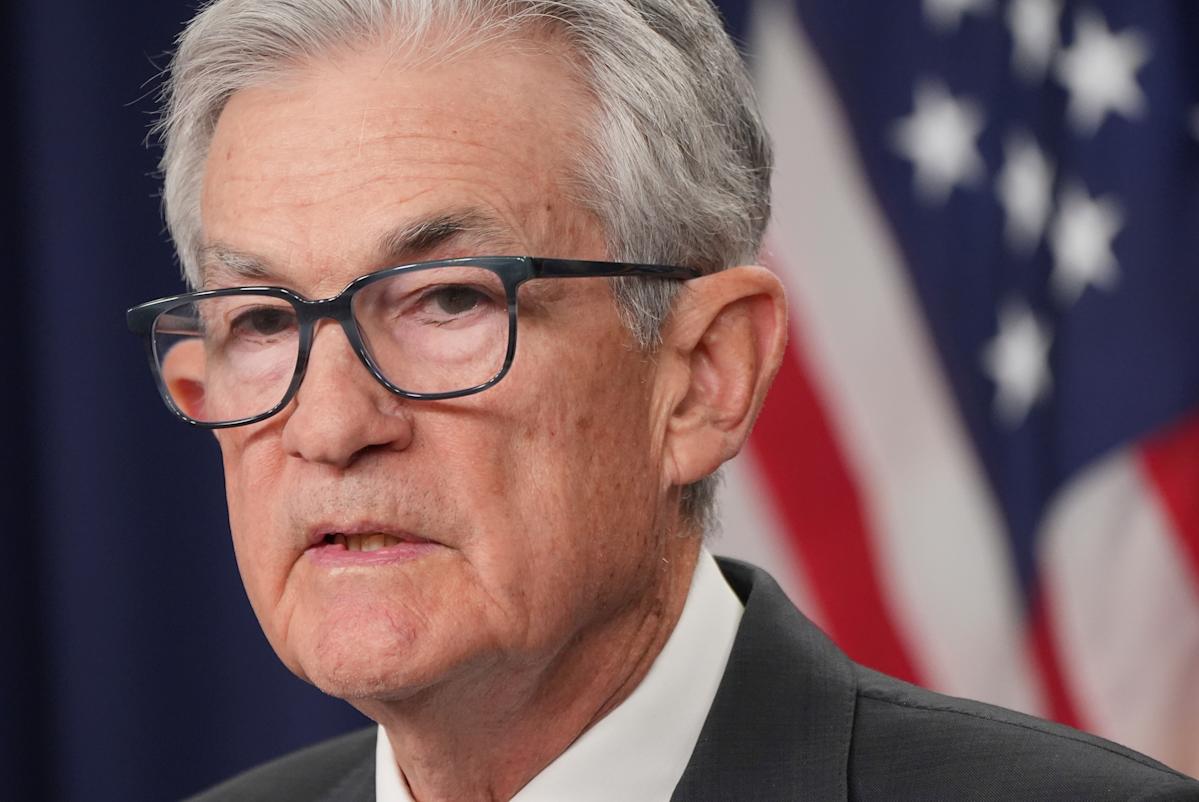
Federal Reserve Chair Jerome Powell speaks at the Federal Reserve, Wednesday, Dec. 10, 2025, in Washington. (AP Photo/Jacquelyn Martin) ·ASSOCIATED PRESS
Next year will also bring a new chair of the central bank for the first time in eight years. The president is widely expected to nominate someone who favors lower interest rates. Even so, the chair could still have a tough time gaining a consensus for lower rates if inflation remains elevated. The Cleveland Fed’s Hammack, a voting member of the Fed next year, has already said she favors holding rates steady into the spring.
Wilmer Stith, bond portfolio manager for Wilmington Trust, said he expects to see continued division into next year with the potential for even more dissents on the committee if the new chair tries to push through rate cuts while others on the committee oppose them.
He also expects the Trump administration to continue its campaign for lower rates.
But Powell is still chair until May, and Stith says as a result, there won’t be many rate cuts in the first part of the year. He thinks we’ll get one cut between January and May.
“I think we are going to get a couple over the course of the full year once we get a new chairperson,” said Stith. “It’s going to be a [central bank] more tied to the administration … than we’ve seen in a long time. So, I think rate cuts are coming.”
Jennifer Schonberger covers the Federal Reserve, Congress, the White House, the Treasury, the SEC, the economy, cryptocurrencies, and the intersection of Washington policy with finance. Follow her on X @Jenniferisms and on Instagram.
Leave a Comment
Your email address will not be published. Required fields are marked *



Leave a Comment
Your email address will not be published. Required fields are marked *