
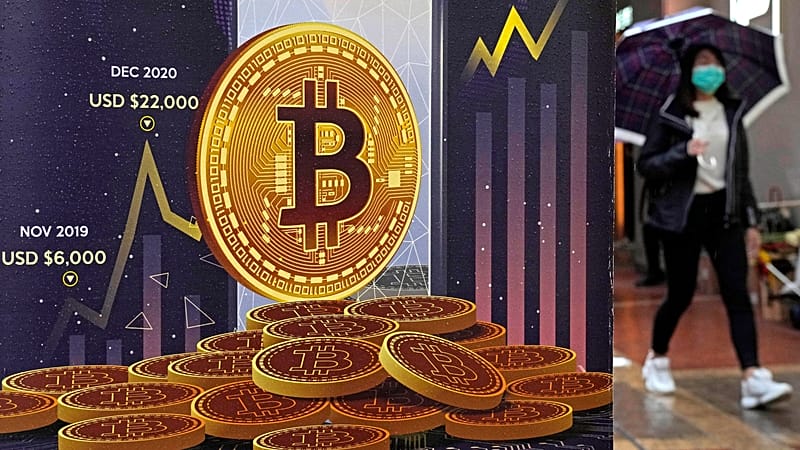

Crypto ownership is on the rise in Europe: Who’s investing the most?
More than 90% of people aged 18 and over in major European economies are aware of crypto-assets or cryptocurrencies.
That’s according to the ‘Web3 Industry in France and Europe’ report by Adan, which uses data from early 2025.
Although the assets have seen their value fluctuate in 2025, crypto ownership is steadily on the rise across Europe.
According to a survey by the European Central Bank, 9% of adults in the eurozone owned crypto-assets in 2024. Among the 20 eurozone countries, ownership ranges from 6% in the Netherlands and Germany to 15% in Slovenia —although the differences across countries are generally modest.
Behind Slovenia in the ranking comes Greece, and then Ireland, Croatia, Cyprus, Lithuania and Austria, which share the next position.
“Country differences in ownership shares are typically driven by a combination of digital adoption, risk appetite, and local market structure,” James Sullivan, chief risk and compliance officer at BCB Group, told Euronews Business.
“Countries with a high degree of financial innovation and a younger, typically male-dominated, investor base tend to lead,” he said.
He also underlined that local regulatory and economic factors are key. In markets where traditional investment options are limited, crypto may be used speculatively, and strong awareness campaigns, like those seen in Italy, can boost adoption.
The UK, despite not being in the eurozone, continues to show high transaction volumes, ranking third globally behind the US and India as of 2024, according to Sullivan.
Ownership of crypto-assets increased in almost every eurozone country between 2022 and 2024. The Netherlands was the only country where the rate stayed the same, and data for 2022 is not available for Croatia. Across the eurozone, ownership rose from 4% in 2022 to 9% in 2024.
Greece and Lithuania recorded the biggest jumps, each rising by 10 percentage points. Cyprus, Belgium, Ireland, Austria, Slovakia, Slovenia, Portugal, and Italy also saw increases of 7 points or more.
James Sullivan stated that the notable rise confirms that European retail interest is strengthening, showing that previous crypto winter chills are now a distant memory for consumers.
“This growing confidence is attributed to the cyclical return of global market momentum, but critically, the consumer protection afforded by the Markets in Crypto-Assets (MiCA) regulation,” he told Euronews Business.
MiCA institutes uniform EU market rules for crypto, covering assets that are not currently regulated by existing financial services legislation.
Leave a Comment
Your email address will not be published. Required fields are marked *