UK-US trade in disarray after Trump tariffs ruled illegal
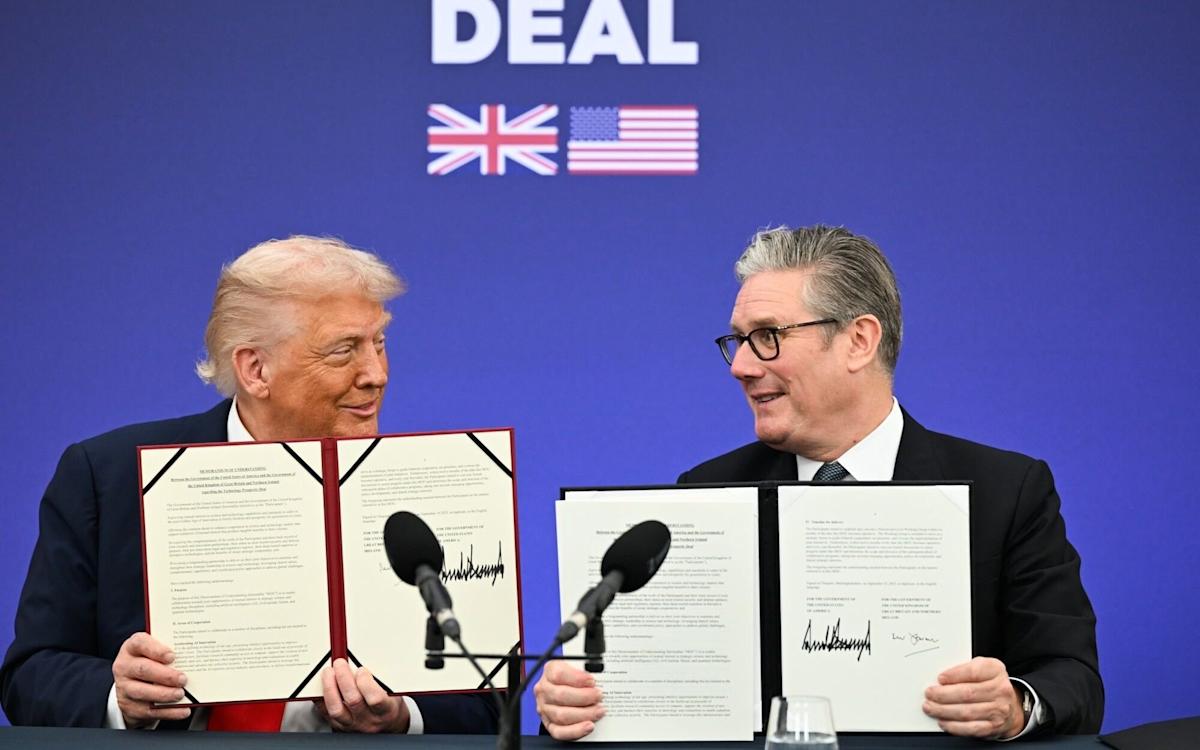
The deal Sir Keir Starmer and Donald Trump struck last year gave British exporters an advantage over other countries – Chris J Ratcliffe/EPA/Shutterstock
The US Supreme Court’s decision to strike down swathes of Donald Trump’s tariffs has plunged Britain’s trade relationship with America into chaos.
The court’s ruling that the president’s “reciprocal” tariffs imposed on “liberation day” last year has annulled the broad 10pc tariff on all British goods sent to America, ranging from power generators and scientific instruments to whisky and cooking oils.
While that may sound like a good thing, the judgment has unleashed a wave of uncertainty about what comes next and left business owners uncertain about how to deal with the US.
Late on Friday, Trump said he would immediately replace his country-specific tariffs, including the UK’s, with a global 10pc tariff.
This would rely on a still-legal mechanism, section 122 of the 1974 Trade Act. But tariffs imposed using this power are time-limited to 150 days, after which the future trading relationship looks uncertain.
It leaves British exporters unsure of their future prices and cash flows in the US market, which each year hoovers up a 16pc share of Britain’s exports, worth about £6bn in 2025.
The Supreme Court judgment left in place Trump’s specific tariffs on British exports of cars, steel and pharmaceuticals. But beyond that, confusion reigns.
William Bain, trade policy head at the British Chambers of Commerce, fears some exporters may give up trying to sell into the American market altogether.
“The situation is fraught with uncertainty for companies here. Among a significant proportion, weariness is setting in, and they may look to diversify to other international markets,” he says.
Exporters to the US no longer know what tariff they will have to pay on their shipments in the second half of the year. The new 10pc baseline tariff can be extended beyond the five-month limit, but only with congressional approval. If Congress votes not to maintain Trump’s new 10pc tariff in the summer, the rate could go back to zero.
Then again, Trump could respond to such a Congress veto with yet another tariff – and the rate could even be higher than the one British exporters face now.
The president hinted at as much on Friday as he announced: “Now I’ll go the way I could have gone originally, which is even stronger than our original choice.”
Sean McGuire, Europe and international director at the Confederation of British Industry, warned that businesses were “concerned by the president’s announcement to press ahead with alternative tariff measures which would have equivalent or greater effect”.
He added: “Business will be looking to the UK Government to ensure that preferential treatment for UK firms remains, continue their efforts to reduce tariffs on steel and aluminium and provide clarity and support for business as the US administration takes its next steps.”
A government spokesman said British officials would work with the Trump administration to “understand how the ruling will affect tariffs for the UK and the rest of the world”.
“The removal of tariffs would in theory be a boost to trade and offer a small positive to the UK economy,” says Thomas Pugh, RSM UK’s chief economist. “However, the Supreme Court ruling raises more questions than answers at this point.”
Whichever way it goes, businesses are already taking orders for the second half of the year, yet they have no idea what to put on the price tag.
Richard Rumbelow, the director of international business at Make UK, the manufacturing trade body, says: “Smooth trade relations between the UK and the US are the key to clarity and stability for the UK’s manufacturing sector. The US is one of our biggest export markets, worth £53.9bn.
“As the situation continues to evolve, businesses now need clear, practical guidance on how the [Supreme Court] ruling will be implemented, alongside progress on resolving the remaining Section 232 tariffs on UK steel and aluminium.”
A UK government spokesman said Britain “enjoys the lowest reciprocal tariffs globally, and under any scenario we expect our privileged trading position with the US to continue”.
It’s true that the judgment does not appear to affect the trade deal that Sir Keir Starmer, the Prime Minister, struck with Trump last year.
That’s because Britain’s 10pc baseline tariff – now ruled illegal – was not a formal part of that agreement. It is not mentioned in the deal text, which focuses on efforts to reduce the sector-specific levies on steel, cars and medicines.
But even if Britain’s deal with the US proceeds as before, it no longer gives British exporters an advantage over anyone else.
For example, the EU previously had a 15pc tariff on goods sent to the US and India had an 18pc charge – meaning British goods had a tax advantage.
Now that is not the case.
Donald Trump at a press conference on Friday after the Supreme Court struck down most of his tariffs – Bonnie Cash/EPA/Shutterstock
The section 122 power lets the president levy tariffs of up to 15pc, but only on a “non-discriminatory basis”.
“That is, one tariff rate for everyone,” Paul Ashworth, of Capital Economics, said in a note.
If every country is treated the same, then the Starmer Government’s hard-won battle to hold Trump to a low 10pc rate no longer gives the UK any advantage over other countries that didn’t do as well.
Not only does Britain no longer enjoy a comparative advantage, the system means that if Trump is tempted, or provoked, into pushing the section 122 rate up to 15pc in future, Britain could not escape.
Trump does have the option to use the power more selectively. He could target particular countries that “maintain unjustifiable or unreasonable restrictions on US commerce”.
But he would have to make a case to Congress that the countries attracting his ire do indeed have such restrictions. They have already baulked, even with a Republican majority, at supporting his tariffs on Canada. It suggests he may struggle to make his case.
For now, last year’s UK victory on a US trade deal now looks a little Pyrrhic for Labour.
Adding to the confusion is the fact that, not only do British businesses have no certainty about what tariff they’ll be paying later this year, they also have no idea if, or how, they’ll get a refund for the tariffs incurred over the past year.
That’s because the Supreme Court did not address the issue of refund entitlements, leaving a legal limbo.
“Any refund process will likely be difficult to navigate and prolonged. And it will require proactive application to US customs authorities rather than being issued automatically,” says George Riddell, managing director of trade consultancy Goyder.
Capital Economics’ Ashworth isn’t optimistic. “Trump did not offer to repay the roughly $110bn in tariffs collected… so we anticipate another long legal fight over those refunds,” he said.
Basil Woodd-Walker, a partner at law firm Simmons & Simmons, says British businesses have to accept that they can no longer rely as heavily on US policy or the US market.
“The lesson for UK and European businesses is clear: a new world order is unfolding, with high levels of uncertainty about the future direction of US trade policy and the international rule of law,” he says.
“It underscores the need continuously to test and adapt business models to those shifts, diversifying supply chains and onshoring where possible.”



Leave a Comment
Your email address will not be published. Required fields are marked *